
I’ve been following Dolores Catherino’s beautiful microtonal music for quite a while and it’s fascinating to get a look into her musical space. Everybody has a different approach to microtonality and hers is certainly different to mine. There are some very cool pieces of kit on display, like the Starr Labs Microzone U-648, H-Pi Tonal Plexus, Haken Continuum Fingerboard, and ROLI Seaboard.
This video also serves as a very inspiring introduction to why one would start using microtonal scales to push music into the future.

She also mentions that we could extend frequencies up above and beyond the range of human hearing (i.e. above 20kHz) with future advancements in sample rate fidelity and loudspeaker design. While it remains to be seen if this would have an effect on our perception of the music, it’s very interesting food for thought.
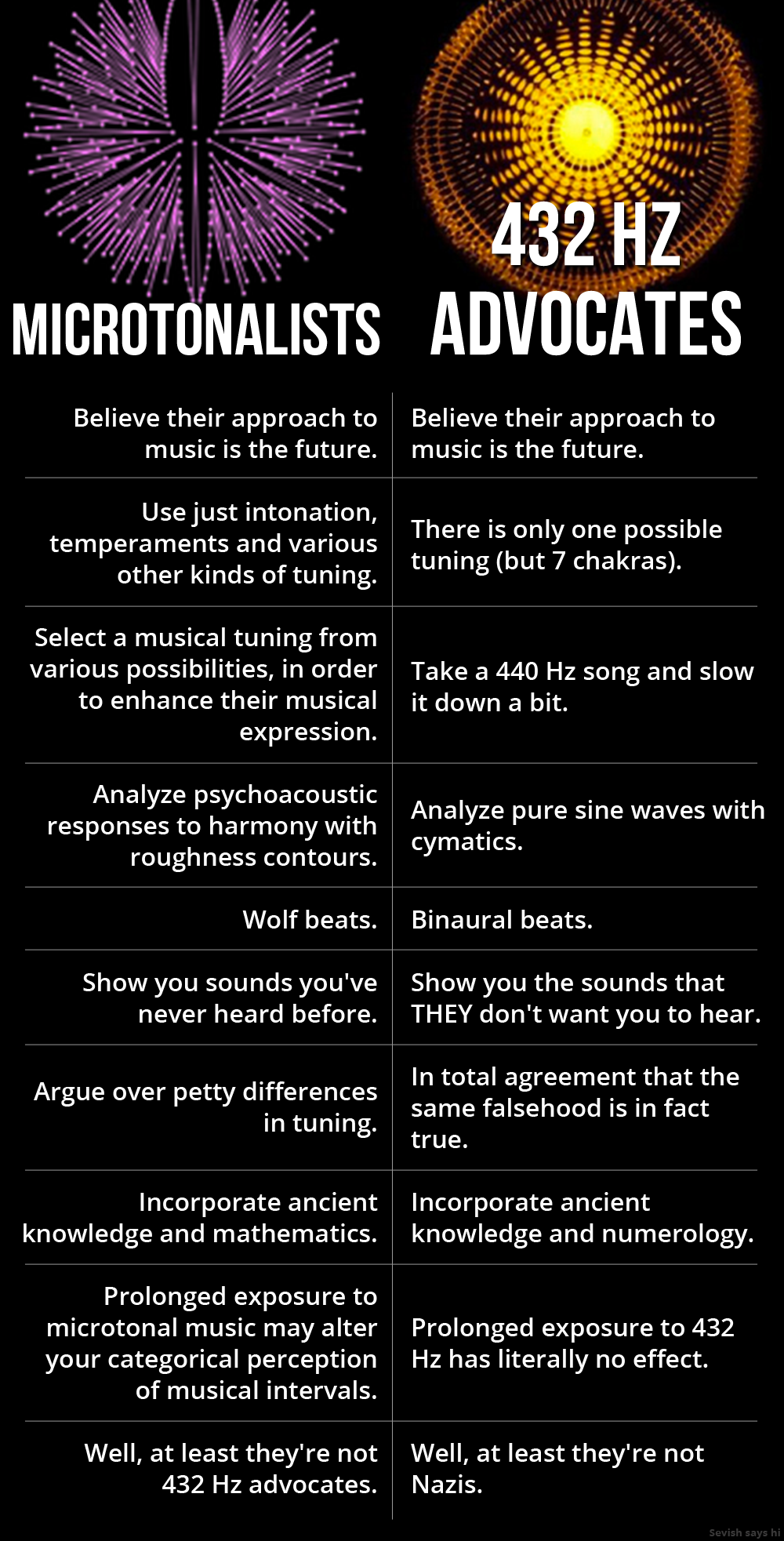
And don’t get me started on those solfeggio frequency guys…
[Update Jan 2023: This article is quite old now. If you’re looking for something more user-friendly than Scala, try Scale Workshop. If you want to learn more about Scala, read on!]
When you want to edit photos, there’s Photoshop. When you want to listen to music there’s iTunes (if you’re a pro at life, there’s foobar2000). When you want to create your own musical scales, opening up endless possibility in harmonic and melodic expression, there is Scala. Scala is a multi-purpose toolkit for everything related to tunings, scales and microtonality. You have a hardware synth that you want to retune? Scala will do it. Or a softsynth? Scala can export the tuning files required to make that happen. Want to generate all kinds of crazy scales that you can use to compose new music? Scala has near infinite options for you to play with. Want to experiment with world music and historical scales? There’s a database of thousands on the Scala website.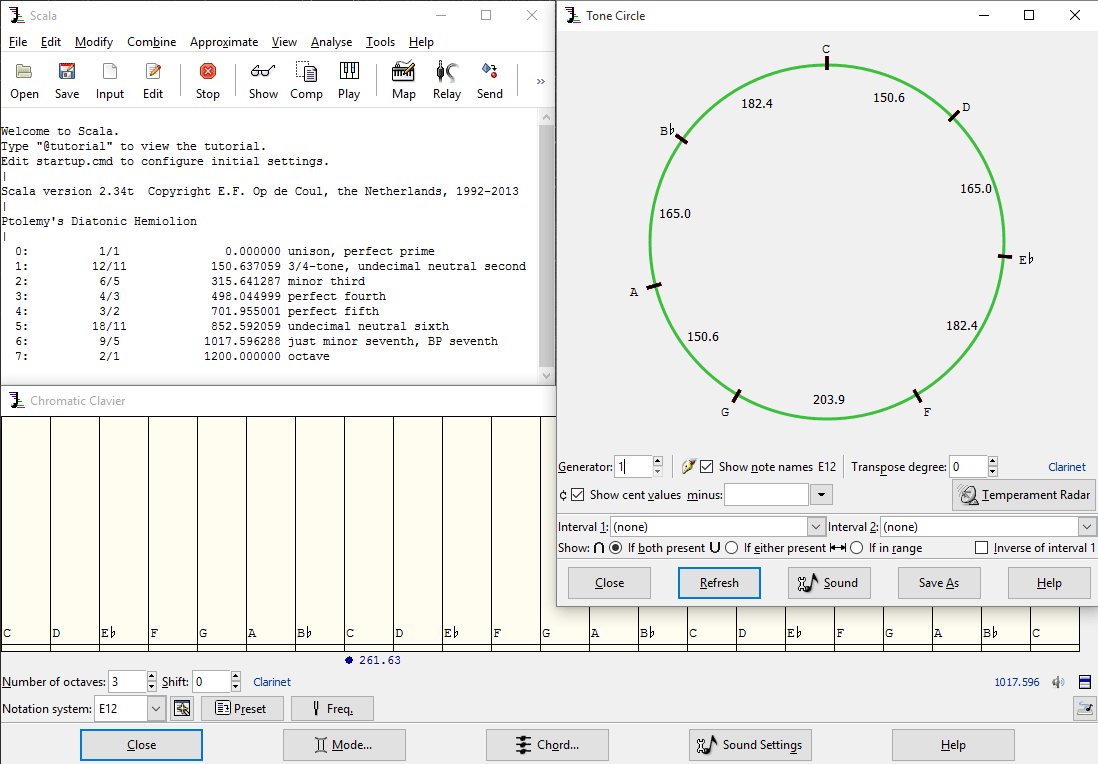 This is a beginner-level tutorial which deals with scale creation and microtonality in a practical way. I can’t attempt to cover everything Scala can do here. But you’ll learn some fundamentals.First I’ll show you how to create equal scales, then I’ll show you how to create just scales. If you don’t know what the difference is, just follow the tutorial from beginning to end, and read some of the links later to fill in the gaps of your knowledge. By the end of this tutorial you will have invented some of your own musical scales!
Equal temperaments are scales that divide an octave into some number of equally big pieces. The 12 note scale of Western music is an example, as each semitone is of equal size. So you already have experience with equal temperament scales and didn’t know it.In Scala, equal temperaments are trivially easy to create!A popular thing that beginning microtonalists like to do is to try quarter tones. The quarter tone scale divides the octave into 24 notes. Let’s make the scale in Scala. Load up Scala, type this line into the text field at the bottom, then hit enter:
equal 24
Explanation: When you type the command equal, followed by a number, Scala will produce an equal-tempered scale with that number of notes in an octave.But it looks like nothing happened after we hit enter. We still need to check that the scale was created correctly. So type:
show
This will show you the tuning data for the equal temperament scale you just created. As below:
0: 1/1 0.000000 unison, perfect prime 1: 50.000 cents 50.000000 2: 100.000 cents 100.000000 3: 150.000 cents 150.000000 4: 200.000 cents 200.000000 5: 250.000 cents 250.000000 6: 300.000 cents 300.000000 7: 350.000 cents 350.000000 8: 400.000 cents 400.000000 9: 450.000 cents 450.000000 10: 500.000 cents 500.000000 11: 550.000 cents 550.000000 12: 600.000 cents 600.000000 13: 650.000 cents 650.000000 14: 700.000 cents 700.000000 15: 750.000 cents 750.000000 16: 800.000 cents 800.000000 17: 850.000 cents 850.000000 18: 900.000 cents 900.000000 19: 950.000 cents 950.000000 20: 1000.000 cents 1000.000000 21: 1050.000 cents 1050.000000 22: 1100.000 cents 1100.000000 23: 1150.000 cents 1150.000000 24: 2/1 1200.000000 octave
Explanation: The equal command that we just used has produced 24 items for us (24 notes in our scale). The show command lets us see those 24. Each of these shows some number of “cents.” The cent is a measurement of how wide or narrow an interval is. Notice that each interval in our 24-equal scale goes up by 50 cents. 50 cents is exactly one quarter tone. 100 cents makes up a semitone, and 1200 the whole octave. Cents are a useful measurement to get your head around if you want to compare tunings with each other.That’s enough staring at numbers. Time to hear these quarter tones for the first time. On the Scala interface you’ll see a button which says play. Click that button!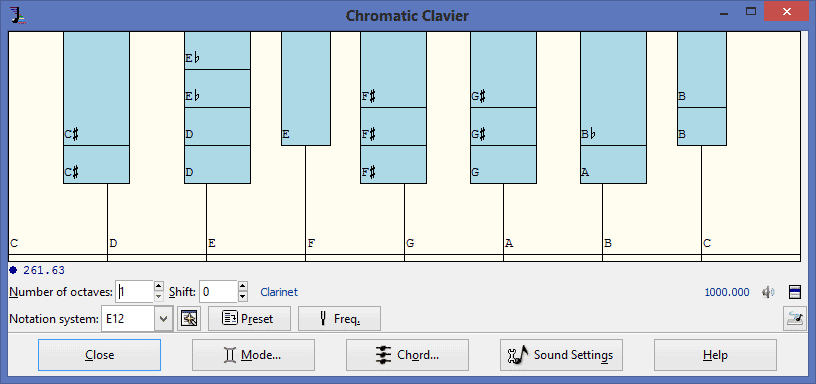 Here’s the “chromatic clavier!” You can use this to try out your scale using your PC’s built in MIDI synth. A very handy tool indeed. Play using your mouse, or use the Sound Settings button to set up a MIDI keyboard controller.
In the first part, we divided an octave into some number of equal parts. Amazingly, we are not limited to dividing octaves. We can choose to divide other intervals instead, such as a perfect fifth or whatever you like. But what’s the point?Every note in a non-octave scale has a unique identity. Consider that we know a note A as a note oscillating at 440 Hz, or some octave above (880 Hz, 1760 Hz) or below (220 Hz, 110 Hz, 55 Hz). If our scale doesn’t include octaves, then a note A won’t have any other counterparts higher or lower in the scale. This means that, as we climb up or down into different registers, we keep hitting unique note identities which haven’t been heard elsewhere in the scale!This approach is extremely fruitful for new sounds, sonorities and progressions. However composition technique must change drastically. For starters, there are no more chord inversions, since you can’t raise any notes up or down an octave. Of course, this makes voicing difficult too. But you gain a very wide variety of intervals to play with, and it will challenge and grow you as a composer to exploit non-octave scales. Just try it and see.Here’s how we do it. We’re going to create a scale which divides a perfect twelfth (an octave plus a fifth) into 13 equally spaced parts.
equal 13 3/1
Explanation: The equal command tells Scala that we’ll be making a scale where all notes are the same size. The number 13 shows that we want 13 notes. And that weird fraction on the end? That’s the big interval that will be split into 13 equal parts. Think of it as a pseudo-octave.Why 3/1? For now just take my word for it. 3/1 is a perfect twelfth. So rather than repeating at the 8th (octave), we’re repeating at the twelfth.Notice, if we don’t include the number 3/1, then Scala will assume that this is an octave based scale. (An octave, by the way, can be expressed as 2/1).Let’s see the cents values for the scale we created:
show
And the result:
0: 1/1 0.000000 unison, perfect prime 1: 146.304 cents 146.304231 2: 292.608 cents 292.608462 3: 438.913 cents 438.912693 4: 585.217 cents 585.216923 5: 731.521 cents 731.521154 6: 877.825 cents 877.825385 7: 1024.130 cents 1024.129616 8: 1170.434 cents 1170.433847 9: 1316.738 cents 1316.738078 10: 1463.042 cents 1463.042308 11: 1609.347 cents 1609.346539 12: 1755.651 cents 1755.650770 13: 3/1 1901.955001 perfect 12th
Can you remember how many cents are in an octave?The answer is 1200 cents. Looking at the above list of intervals, we can see there’s no value too close to 1200 cents at all. But there’s this nasty 1170 cents interval that’s gonna sound noticeably flatter than an octave. On the other hand, that perfect twelfth at 1901.955 cents, is purely in tune. Whatever this scale is, it doesn’t represent anything we’re used to in Western music. There’s no perfect fifth, no octave…The scale we’ve just created is none other than the Bohlen-Pierce scale, a famous non-octave scale with many interesting properties. It sounds very alien until you have taken time to immerse yourself in it. Jam with the chromatic clavier and hear it for yourself (remember, just click the play button on the Scala interface to do this).
The topic of just intonation (JI) is deserving of several books in its own right. It is an old mathemusical theory in which many cultures have their own take.What could a name like “just intonation” mean… If you think of “just” as meaning fair, right, exact, and perfect – and intonation of course having to do with the accuracy and flavour of the pitch – then you should get the general idea. Just intonation is a tuning system that uses exact, perfect intervals.In fact, the pitches of just intonation are made up of ratios. Think of numbers such as 2/1, 3/2, or 15/8. (These intervals are an octave, perfect fifth and major seventh, respectively).
Time to get creative! There are many ways to go about making your own just scale, but here’s one way that can get you exploring quickly.On the main Scala window, click on the Input button to open up the Input Current Scale window. Here you can enter the pitches you want to use. In this case we’ll enter some fractions at random, following some simple guidelines.
Below are a few examples that follow the above guidelines.
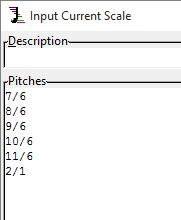
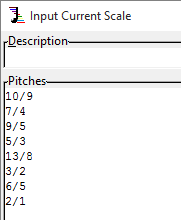
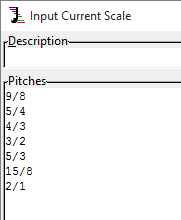
You can also use Kyle Gann’s anatomy of an octave to find some interesting numbers to plug in.Once you’re done, hit OK and you’ll be taken back to the main Scala window. At this point you will find 9 times out of 10 that Scala says “Scale is not monotonic ascending.” If you saw this message then it means that the pitches of your scale are in a weird order. To fix this issue, tap the Edit button on the main Scala window, tap the Ascending button, and finally click OK.Let’s take a quick look at what you made:
show
Take a quick look at the interesting names that Scala gives to the ratios you randomly chose.Now it’s time to hear your scale! Hit the Play button to show the Chromatic Clavier. You can hold shift when you click to hold multiple notes down and hear that solid JI sound.Alternatively you can play your scale using a connected MIDI controller or MIDI keyboard. To do this just click the Relay button on Scala’s main window and then click the Start Relaying button.Repeat this process of JI scale creation a few times, each time playing your scale using a keyboard to get a feel for the unique musicality of each one.Once you become comfortable with this process and you get to know certain ratios that you love the sound of then you can start to ignore the guidelines I gave before.
Now you know how to come up with a just intonation scale of your own. But you still might not know why you would want to use just intonation. There are many differing opinions out there and it’s easy to find them using Google. And I recommend you spend a lazy afternoon doing just that. Here are a few suggestions:
Here’s an improvisation from a few years back, warts and all. It’s a microtonal piano piece.
Seems like there are tonnes of Max OS X users who want to get into microtonal music but don’t know how to jump in. Although I’m a Windows-using peasant, I wanted to gather up some ideas to start you off. Let’s dip in…
Logic Pro supports microtonal scales, and can even load Scala files! This can retune all of its built-in instruments and synthesisers (it doesn’t apply to any AUs or VSTs you’re running).
This online help file from Apple shows you how to find the tuning settings in Logic Pro X.
The big drawback—and I mean huge—it only supports 12-note scales, those scales must repeat at the octave, and each note can only deviate from 12-tet from plus or minus 100 cents (1 semitone).
These limitations restrict you to certain kinds of microtonal scales, and while there’s certainly room to explore within these limits, you’ll miss out on whole genres of microtonal scales that will blow your mind. You’ll miss the unimaginable cloud-like non-octave scales like Bohlen-Pierce and Wendy Carlos’ scales. Stretched-octave scales like Indonesian Slendro and Pelog also can’t be tuned faithfully. And large scales such as the 20-note eikosany, Harry Partch style just intonation, or large equal temperaments, are straight out unavailable.
Nevertheless, Logic makes it easy to microtune its high-quality instruments, even if it is crippled, so if you already own Logic then you should definitely check it out.
If you’re using a DAW that supports AU or VST plugins (such as Logic, Ableton Live, and some others) then you can make microtonal music by using certain plugins that support full microtuning. They can usually import a tuning file and that sets everything up for you.
It should come as no surprise that there are less *free* options for microtonal composition on a Mac than there are on Windows or Linux. But you can start with alphacanal Automat and Plogue Sforzando
If you’re willing to spend a little, then have a look through the big list of microtonal software plugins on the Xenharmonic Wiki.
Some people report success running Xen-Arts’ Windows-only VSTs using the free emulator WINE and a free VST host. If you’re of the technical mind to set up WINE, there’s a world of free VST synths for Windows awaiting you!
If you want to design your own tunings and export them for use in other instruments then there’s the Custom Scale Editor (CSE) software from Hπ Instruments. It allows you to tune every MIDI note to whatever pitch you want, exports tunings in a variety of popular formats and can retune the output of sequencers and notation programs. Thanks to Juhani Nuorvala for reminding me to mention it!
I heard that the now discontinued Lil’ Miss Scale Oven was the way to go. Really, I’ve heard wonderful things and wish I could have a little play with it myself.
It’s also possible to install Scala on OS X for free. I’ve never been through this process, but I’ve heard that it’s one of the most challenging things you can attempt to do.
Follow the instructions on the Scala website, and go slowly and carefully. You will be confused. You will have to install other things to get it to work. You will want to cry. But it IS possible…
Max/MSP, Pure Data and CSound are audio programming languages that can let you make sounds from the ground up. If you’re the tinkering type then try these!
Microtonal equal temperaments on a Max/MSP synth using expr
How to play microtonal scales on a Max/MSP synth
If you have any other methods of making microtonal music in OS X then get in touch so I can update this post!
I like to think that the machines were here on Earth since the beginning, and they were just waiting for the right time to show themselves to humans. They were making music in 12,000 BC and it sounded just like this new xenharmonic release over on the Dubbhism netlabel!
Strictly Binkie is all about self-generating modular dubbs (how many b’s are appropriate here)?!
You know how we roll… Free will is for losers, intelligent robots are taking over our planet. Hollywood and Silly Con Valley have been warning us for years, but Dubbhism is not sleeping on this. We bring you the next step in dubb: the Dubbularity. Big fat fully automated, self-generating, self-programming dubbs for the Kurzweil Generation.
Mixed by Binkieman, a dutch dub artist who’s custom built modular robosynth spits out weird algorithms, encrypted electronic messages, nasty basses and reverb-soaked rimshots. Bang the Binkie drum!!
Release page: http://www.dubbhism.com/2015/09/out-now-binkieman-strictly-binkie.html
Download: http://www.dubbhism.net/netlabel/dubbhism-netlabel-022-binkieman-strictly-binkie.rar
Just hit play and then keep reading.
ILEVENS describe themselves as a psych-pop band.
So what, you say? Well compared to other acts who are working within this style, you might (if you’re like me) notice something you just can’t put your finger on with the sound. Something sounds almost brighter, deeper, richer… What is that?
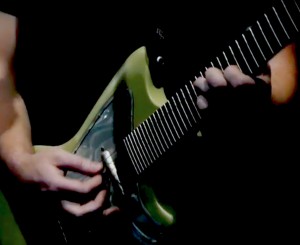
Take a closer look at the guitar. There are way too many frets on that damn thing. What’s going on?
Well ILEVENS are playing in a new intonational system that abandons traditional musical values. In other words, this music is microtonal. They’re using a system with 22 steps in an octave.
Shit, somebody has finally done it! Somebody has finally made microtonal music that’s not all theory and MIDI trumpet sounds!
ILEVENS’ frontman Brendan Byrnes isn’t just the handsome face of the band but also a bit of a mastermind for bringing this group and this sound into existence.
You see, it’s now very clear that having depths of knowledge about microtonality (read: the future of music) isn’t enough to get people interested in this style. You need to have the ability to write clearly, play with enthusiasm, and have fun. ILEVENS do this to such a high degree that it becomes “music” first and foremost and “a whole new paradigm of musical intonation” second. That’s the way things should be. That’s how we can show the world what microtonal music can do.
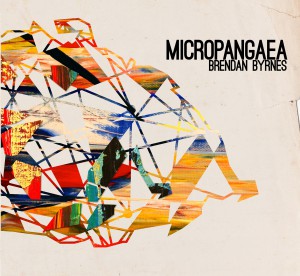
Brendan also made the rather mesmerising Micropangaea album a couple years ago, so if you’re getting into ILEVENS then this is recommended listening too.
I will be live-streaming another music making session this weekend! Tune in here:
http://www.twitch.tv/sevishmusic/
Sunday 2:30am UTC (Saturday 10:30pm EST)
This time I will be attempting to start a new track, so you’ll get to see my creative process from the beginning. We’ll kick off with scale creation and I’ll be creating a new musical tuning specifically for this piece. Make sure you sign up for a free Twitch.tv account so that you can get involved in the live chat.
It will be my second time doing a live stream. First time had a few technical problems, but next time things will be smoother. Bits of the first session have been archived on the above link in case you want to catch up.
My piece Guano Sequence was featured in a compilation album from the music blog Can This Even Be Called Music?
There are some really far out sounds on this album, so check it out! Can This Even Be Called Music promotes unique underground bands and genres by reviewing their music, art, and lyrics. Dave Tremblay, who founded the blog, is even a microtonal musician in his own right!
Last weekend I put on a live stream about making microtonal music in Ableton Live. While there were a few technical issues, I did manage to get my head into a spacey improvisation in the Bohlen-Pierce scale. The improvisation was played with my AXiS-49 by C-Thru Music (a company which unfortunately went out of business recently).
The Bohlen-Pierce scale provides an exciting alternative to the Western 12-tone equal temperament. Instead of using major (4:5:6) and minor (10:12:15) triads as the basis of its harmony, it uses 3:5:7 and 5:7:9 “triads”. The ratios refer to the frequencies of the notes which form its harmony. To my ear, BP is spaced out, sparse and atmospheric. It sounds alien but it makes sense in its own weird way.
Actually the chords that are in the background of my improvisation don’t use the 3:5:7 or 5:7:9 chords, but to my ear they still capture that unmistakable BP sound. Definitely a great xenharmonic scale to go back to now and again.
If you want to hear more, you’ll find a plethora of Bohlen-Pierce recordings on YouTube.
For more reading, check out the Bohlen-Pierce site!
And just for good measure, here’s another Bohlen-Pierce track that I wrote way back in 2010.