
My recent EP, MK-SUPERDUPER, is now fully streamable on YouTube.

If you enjoyed MK-SUPERDUPER, you can buy the download on bandcamp. It now has a bonus track ‘The Sky Are Sick’ included, which is an ambient piece that shares the same chord progression as the title track of the EP.
UPDATE August 6th 2020 – this post is now out-of-date because Bitwig have released the Micro-Pitch device. It is excellent so go and check it out. You can still read the rest of this article below to get a sense of life in the before time. :)
If you’re making music with Bitwig Studio, did you know it is also capable of playing microtonal music? It’s not difficult to set up – in fact Bitwig is already a shade above Ableton Live in terms of microtonal scale support. In this article I’ll discuss some possibilities and limitations for microtonal music in Bitwig Studio.
If you’re the kind of musician who wants to compose standard Western tuned music with the occasional microtonal melodic intonation, then the pitch bend method is an easy way to go. Bitwig essentially locks you into standard Western tuning (12-tone equal temperament) as a tonal framework, and you can specify your deviation from that tuning on a per-note basis.
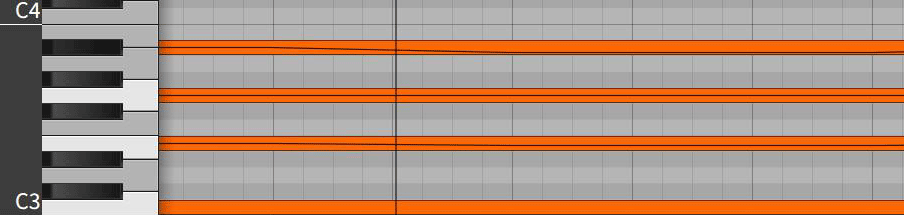
Yes, you heard correctly. Bitwig supports per-note pitch bend for its built-in instruments! This really lowers the barrier of entry for a basic level of microtonality.
But if you want to go deep, using a microtonal scale as your tonal framework, then things start to get fiddly because you’ll be using those pitch bends on almost every single note. Copy and paste will be your friend here.
Remember that per-note pitch bend does not work for VST instruments. The MIDI spec doesn’t support per-note pitch bend, so this technique only works for the Bitwig internal instruments that share Bitwig’s own unique data structure.
You can use the Note MOD device to grab note information from any instrument track. That information can then be used to modulate other parameters within Bitwig’s instruments or effects.
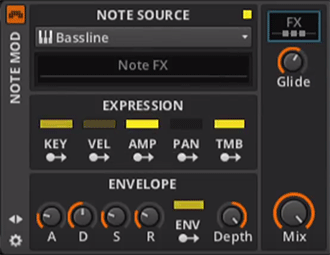
The Note MOD device can be set up to allow you to play in microtonal equal temperaments with the Sampler, FM-4 and Polysynth instruments. That’s because these 3 instruments have a Pitch setting that can be modulated. Use the Note MOD device with the KEY modulator to modulate the Pitch setting of your instrument. A negative value will cause the notes to become smaller than a semitone, while a positive value will cause the notes to become larger than a semitone.
This gives you a world of microtonal and macrotonal equal tunings to explore. But note that this method won’t allow you to play just intonation scales or other unequal scales.
Of course, due to the fact that Bitwig supports VST instruments, you can simply load up tried-and-true VST instruments that support microtonal scales.
If you have a synth that can be tuned via tuning file import, then you’ll need to know how to generate those tuning files or you could simply download a few ready-made tuning packs. And don’t forget to check your synth’s manual to find out how to import your tuning files.
This method doesn’t update the look of your piano roll even if you update the tuning in your VST instrument. So you’ll be stuck in a piano roll scordatura hell, where the notes on the piano roll don’t quite match up with what you’re hearing. But don’t worry, most other DAW microtonalists are in the same ring of hell as you. Get cosy, I’ve been here for years.
In the past, SysEx was how MIDI devices sent and received data for their specific functions. This was a long time ago, before everything was done in the box with a GUI. Some new VST instruments and many old keyboard synths support microtuning via MIDI Tuning Standard (MTS) SysEx messages.
It looks like Bitwig doesn’t support SysEx messages yet (as of Spring 2016), and we’re not sure if it ever will. So MIDI Tuning Standard based microtuning is ruled out for now, sorry. Let’s hope the developers will implement it for all us nerds in the future. Cross your fingers, say prayers, burn incense, and send the developers a feature request…
If you’re using the Xen Arts plugins in Bitwig Studio under Windows or WINE then you’d better just load the .mid tuning-dumps via the UI directly on the synth itself.
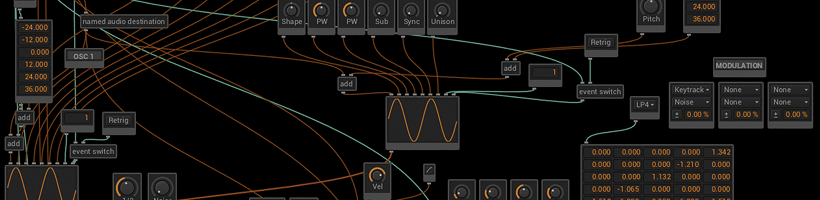
In the core of Bitwig Studio there is a hidden modular environment that will later be opened up for musicians and tweakers to patch into. Without a doubt, Bitwig’s modular system could be used and abused to bend the notes in any which way you choose. Let’s wait for this one and see what the future holds.
If Bitwig Studio’s modular system inspires the same kind of sharing culture that Max for Live does, then it’s only a matter of time before some bright spark patches a microtuner plugin or microtonal synth in Bitwig modular.
If you know any other ways to squeeze a microtonal scale out of Bitwig Studio then drop a line in the comments.
Sleep Deprived Cooked Alive is a drum & bass track from my album Rhythm and Xen. It’s written in 14-EDO (a microtonal tuning). It’s definitely one of the more popular tracks, so I’ve decided to release the remix stems for free.
Download the Sleep Deprived Cooked Alive remix stems pack
The pack includes audio stems, MIDI parts and tuning files to help you tune your synthesizers to 14-EDO. Refer to your synth’s manual to see if it supports these files. This should be enough to get a good remix going, or just to study my work if you’re learning microtonal music.
If you make anything with these stems then let me know! I would love to check it out.
Sleep Deprived Cooked Alive (stems pack) by Sevish is licensed under a Creative Commons Attribution 4.0 International License.
Based on a work at https://sevish.bandcamp.com/track/sleep-deprived-cooked-alive.
You might think that the humble piano roll has already been perfected. But more and more people these days are working with microtonal tunings. The old piano roll struggles to keep up with this new form of musical expression.
Definition of microtonal tuning: Any collection of pitches that is tuned differently to 12-tone equal temperament. A microtonal tuning may contain less than 12 or more than 12 notes per octave, and it may not repeat at the octave at all.
We could improve the piano roll to make these musicians’ lives easier. Here are some reasons why this is so:

Quartertone music displayed on a piano roll designed for semitones
The common pattern of 7 white and 5 black keys is known as the Halberstadt keyboard.
Halberstadt’s layout makes sense if you’re using standard tuning. Those black and white notes provide a useful guide to the eye to see what is going on with the music. However, when microtonal tunings are used, this guide no longer represents what is happening in our music.
Microtonal tunings can have less or more than 12 notes per octave. So as you go up and down by octaves, the markings on the piano roll slip further and further away from a true representation of the notes.
Let’s consider the case of 19-EDO (19 Equal Divisions of the Octave or 19-tone equal temperament). This tuning has 19 notes in one octave. We can play a C major triad in 19-EDO, though the notes are more spread apart than they would be in 12-EDO (standard tuning). In 12-EDO a major triad can be formed with the scale degrees 0-4-7. In 19-EDO the scale degrees are 0-6-11. When you view a 19-EDO C major triad on the standard piano roll, it confusingly looks as if the chord is formed with the notes C, F# and B.
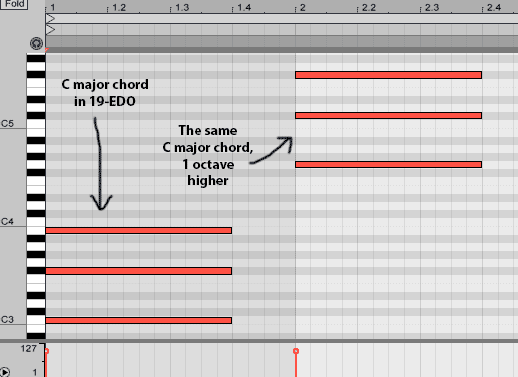
This image should demonstrate that when you transpose the chord up one octave, the notes of the chord appear to change to G, C#, F#.
It was difficult enough to imagine that the notes C, F# and B would make a major triad, but to think that the next G, C# and F# produce the same chord one octave higher is an insane and disorganized way to work. Yet as a microtonalist this is how I have been forced to work with a piano roll every day for years.
And all this has just been an example in 19-EDO. A musician could be working in myriad other possibilities! The existing piano roll isn’t designed for this kind of flexibility, but we can change this! (Indeed Reaper’s piano roll is already head and shoulders above the rest, as I will explain later).
Points for improvement:
To clarify: DAWs send MIDI data in to the instrument/plugin and then receive audio out. The DAW isn’t aware if the musician has loaded a microtonal tuning in the instrument – indeed the DAW doesn’t need to know. Therefore the points for improvement suggested above are cosmetic. There is no need to completely change the way that audio is generated in the DAW. Just change the way that pitches appear to the musician.
Many piano rolls allow you to use the shift+up shortcut to move a note up by 12 notes, or shift+down to move it down by 12 notes. This is a quick and useful method of moving notes up and down by an octave when using standard tuning. But if the user uses a larger or smaller tuning, then this shortcut becomes less helpful.
For example, when I’m working in 22-EDO, I must use an unusual series of keypresses to move a note up by one octave: shift+up shift+up down down. What this does is move the note up 12, up 12 again, then down 2 notes. This clearly isn’t an optimal way for me to jump by an octave of 22 notes.
Points for improvement:
Being an Ableton Live user, I often look at the Reaper guys with jealousy. Reaper is a rock solid DAW and their piano roll has some useful features for microtonalists.
Notice anything remarkable about the piano roll below?
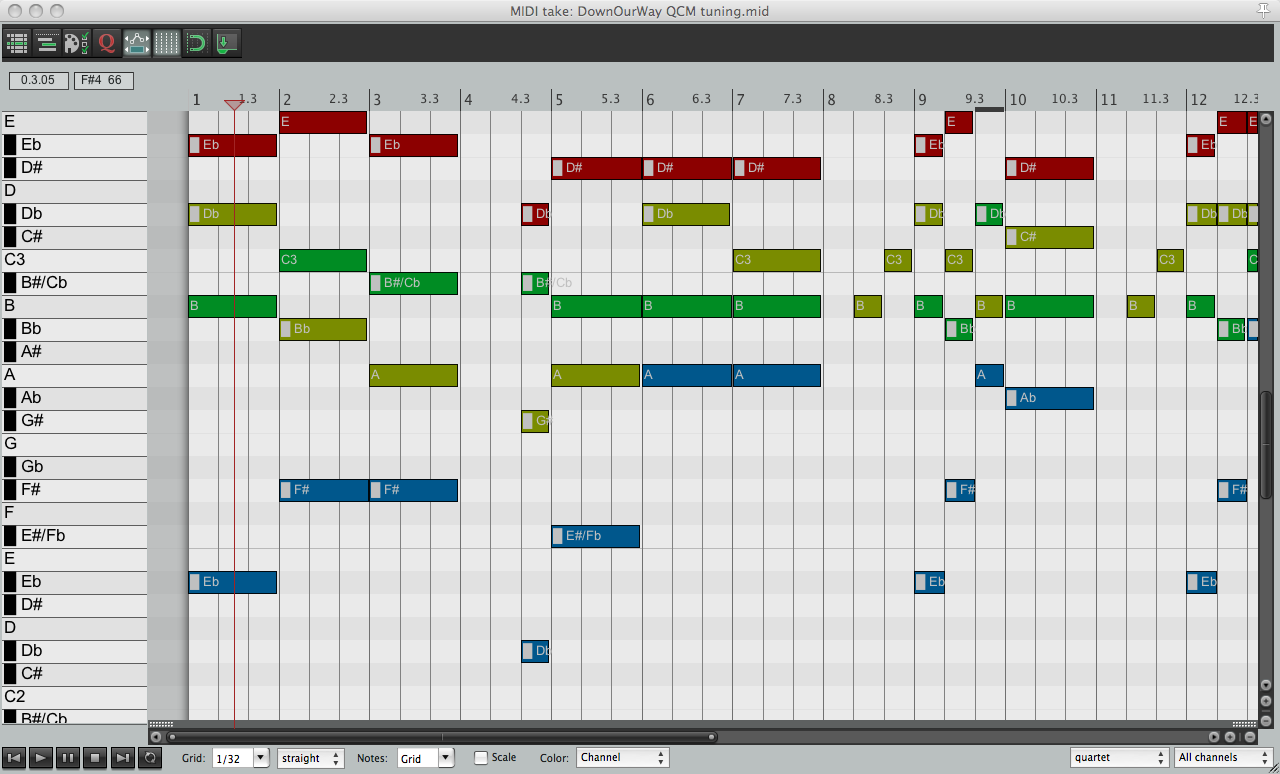
On the above picture, check out the notes on the left side. Here the musician Tall Kite has set up the piano roll with a custom layout and useful names for each note. Yes, Reaper allows you to do this! The custom keyboard layout is designed for 19-EDO.
Read this thread for instructions on how to make a microtonal piano roll in Reaper.
Reaper’s implementation is not perfect. Notice how the background markings on the main panel still show the original Halberstadt layout for 12 notes. Those markings don’t correspond to the layout on the left of the screen. But Reaper’s piano roll is a great move in the right direction. I hope Reaper will continue this good work.
Musicians… Nobody will improve the piano roll unless we tell them about it! Write to your favourite software developers and explain to them what issues you have. Show them examples of other software that does the job well. Show them this page! Then spread the word so other musicians can do the same.
We now have a group on Facebook to help you make feature requests: MIRAGE – Microtonality Request Action Group Effort
Audio developers… At this stage, any audio software that caters to microtonal musicians has a unique selling point to differentiate against similar products on the market. So be a leader in supporting microtonal features to inspire a new generation of musicians. Help artists to create the future of music – not to do what has been done before.
Soon on the MIRAGE group we’ll have resources and recommendations for developers to support microtonality.
For this month’s #SaveShenmueHD tweetathon I decided to make a remix of the Shenmue I Slot House music using Mega Drive FM synth sounds. Mega Drive / Genesis geek for sure.
Well, I didn’t use an actual Mega Drive, but I did use FMDrive which sounds as perfect as I can tell. It’s easy to fall in love with that Yamaha YM2616 sound.
A few months back I remixed of the Fields of Time music from Chrono Cross, so if you are a Chrono fan you should check that out too:
A lot of people who are familiar with my work will also be familiar with Dolores Catherino’s hugely inspiring music. She uses the Tonal Plexus keyboard controller to make very spacey electronic music with an 106 note per octave scale. (Yes, that’s the very in-tune 53-EDO multiplied by 2, just cos).
Check out her TEDx talk from January this year for her perspective on microtonality. She also has lots of music on her dolomuse YouTube channel. Crucial stuff.
Sevish has released his new EP titled MK-SUPERDUPER and you can get it now from bandcamp. MK-SUPERDUPER has 3 tracks of lush, liquid, atmospheric drum’n’bass using microtonal tunings.
The download includes a PDF liner notes booklet – check it out to discover how MK-SUPERDUPER got its name. Enjoy the new sounds!
Here’s the thing. I don’t actually like the definition of the word “microtonal.” Well, I’m sure I’m not the only one.
It’s always tricky having a word which is defined by which it is not. And microtonal means any music that uses intervals smaller (or larger) than a Western equal-tempered semitone. Essentially, we can take microtonal to mean any music or scale that isn’t 12-tone equal temperament. This just elevates 12-tet to something much bigger than it really is.
Many microtonalists I talk to these days see the tuning space as containing an infinite number of tunings; 12-tone equal temperament being just another one of them. But the word we use to describe this tuning space really only includes all of those tunings but one (12-edo). Why the disconnect between the definition and the reality?
“Xenharmonic” suffers the same problem. This word means any music that sounds different to 12-tone equal temperament. (Let’s just put aside the slippery problem of what sounds different today becomes familiar tomorrow).
I would prefer xenharmonic to mean: music that sounds different to ANY traditional music (not just Western music). For example, I wouldn’t class maqam music as xenharmonic, because it’s a traditional music. This seems a more useful distinction to make and it removes the cultural bias currently present in the term.
I know that others will disagree, and that’s just fine. Languages and cultures shift all the time.
Microtonal music watch!
Some great music coming from David Fiuczynski this month. I cannot get over the amazing combo of Dilla-esque beats, bird calls and David’s microtonal guitar playing. Looking forward to getting the whole album, but for now this video is a perfect teaser…
You can buy a limited edition yellow LP, CD, or download it from RareNoiseRecords.
Sevish’s new EP MK-SUPERDUPER will be released on April 1st. MK-SUPERDUPER is all about liquid dnb and experimental bass music with xenharmonic scales. I just made a short video on YouTube for the preview.
I had a lot of fun writing these tunes so check them out next Friday!
